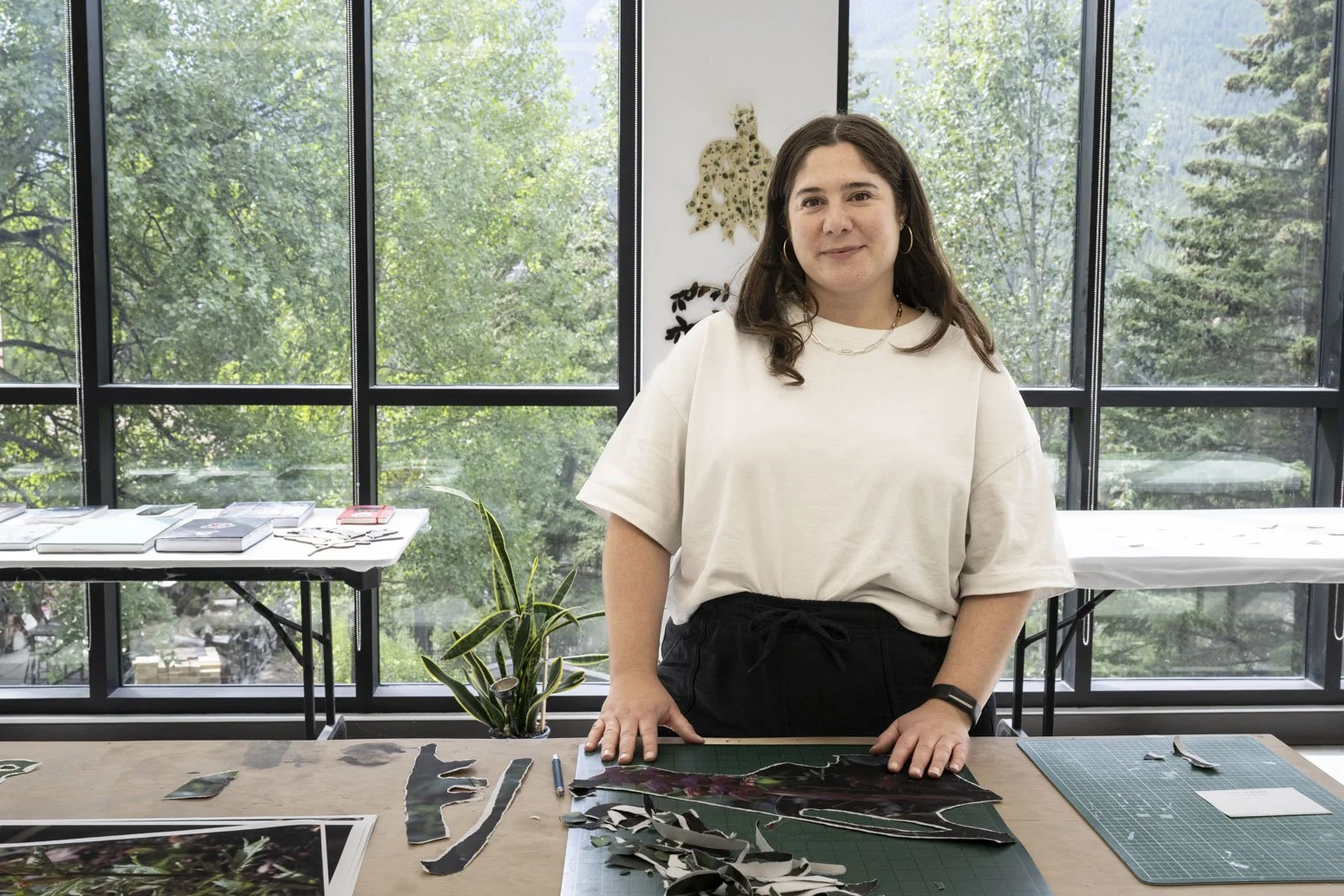
Biography: Natasha Faye Jensen is a dual Canadian and United Kingdom interdisciplinary artist from Moh’kins’tsis (Calgary), located in Treaty 7 territory in Southern Alberta, Canada. Working across sculpture, collage, photography, and film, her research-driven practice examines the intersections of ecology, materiality, and colonial history, with a particular focus on cultivated landscapes as contested sites of power.
She received her Bachelor of Fine Arts from the Alberta University of the Arts (formerly the Alberta College of Art and Design) in 2013 and completed a Master of Arts in Contemporary Art Practice at the Edinburgh College of Art in 2020. Her work has been presented in solo and group exhibitions, screenings, and festivals across Canada, the United States, Finland, and the United Kingdom.
Jensen’s practice has been supported through grants from Calgary Arts Development, the Alberta Foundation for the Arts, and Creative Scotland. She is the recipient of several awards, including the RSA Barns-Graham Travel Award (2020), the RBC Emerging Artist Award from the Mayor’s Lunch for Arts Champion and Visual Artist and Craft Maker Award from Creative Scotland.
Artist Statement: My artistic practice investigates the intersections of ecology, history, and materiality, focusing on gardens and cultivated landscapes as active, contested sites of power rather than passive or decorative spaces. Working across sculpture, collage, photography, and film, I examine how landscapes carry the intertwined traces of natural processes and colonial histories. Systems of classification, cultivation, and extraction have shaped relationships between people and land, embedding ideology into soil, plant selection, and design. Through research-driven methods, I explore the tensions between the natural and the artificial, revealing how landscapes are constructed, managed, and politicized.
My current research centers on Canada/Turtle Island between 1850 and 1870, a formative period when enduring systems for organizing, dividing, and extracting land were solidified. Through archival research and fieldwork, I consider how gardens and cultivated spaces functioned as instruments of colonial expansion, ecological control, and social organization. These histories continue to inform contemporary environmental policy and land stewardship. By tracing their origins, I seek to understand how historical frameworks persist within present-day attitudes toward conservation, property, and resource management.
Material inquiry is central to my approach. I work with sustainable and organic materials to produce abstract sculptural forms that echo botanical and geological structures. These forms suggest growth, erosion, accumulation, and rupture—processes that mirror both ecological transformation and historical intervention. Layered photographic and collage-based works bridge past and present, combining archival imagery with contemporary gestures. This layering creates visual and conceptual friction, allowing multiple temporalities to coexist within a single frame.
Collage is fundamental to my methodology. The acts of cutting, tearing, and reassembling images parallel historical processes of displacement, fragmentation, and extraction. Seams, absences, burns, and surface disruptions remain visible, functioning as records of ecological and cultural rupture. These gestures emphasize irreversibility while resisting seamless reconstruction. I source imagery from Canadian garden, travel, and nature publications from the 1970s, a decade marked by the emergence of environmental protection policies. By physically intervening in these idealized and glossy representations through burning, rubbing, and scratching I interrupt their authority and expose contradictions embedded within narratives of environmental stewardship. The resulting works ask how environmental consciousness can coexist with ongoing systems of exploitation.
While my work confronts challenging histories, it also seeks to cultivate collective reflection. By inviting viewers to reconsider their relationships with cultivated landscapes, I aim to foster empathy, shared responsibility, and attentiveness to the land. Through research, material experimentation, and collaborative exchange, my practice engages the past not as a closed chapter, but as an active force shaping our ecological present and possible futures.